Cantata for peace
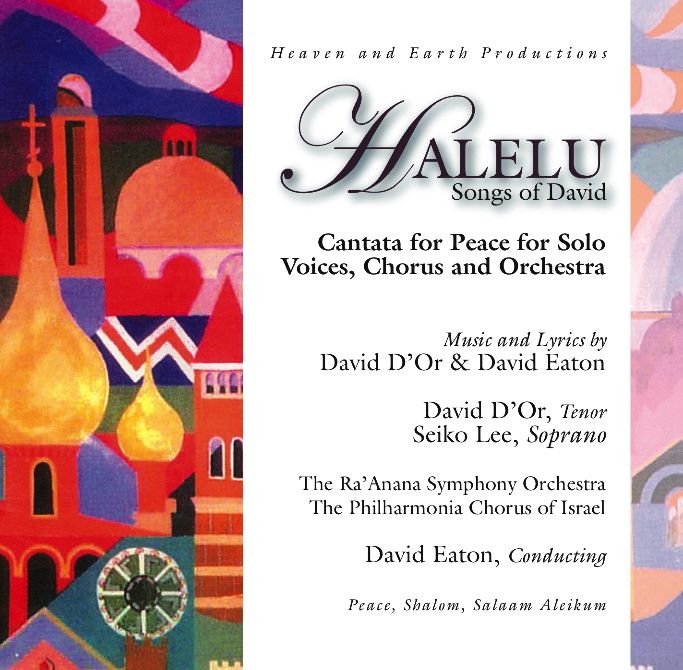
Halelu: Songs of David
My first visit to Israel was in December of 2003. The second Intifada was still underway and hotels were virtually empty due to the ongoing hostilities. Being that it was the holiday season, I was struck by the somber atmosphere that hung over Jerusalem like an ominous dark cloud. On this particular occasion, I was in Israel to produce a Middle East Peace Initiative (MEPI) interfaith peace rally and concert at beautiful Independence Park in downtown Jerusalem, just a short distance from the American Embassy. The tree-lined park was an island of calm in an otherwise tension-riddled city. The rally attracted over ten thousand people—Christians, Muslims and Jews—who gathered on this occasion to advocate for non-violent solutions to the seemingly intractable problems that plague Israel and the Middle East. A significant line item in the production budget for the rally was the fee for armed security for the event, a requirement that was mandated by the municipality of Jerusalem. Fortunately, there were no incidents on that brisk, sunny day and the spirit of peace and goodwill was palpable. The local production company that we hired to handle the staging and sound aspects of the rally mentioned that this event was unprecedented in its public display of interfaith cooperation.
I returned to Israel on two occasions in 2004 and it was on my third visit that I met David D’Or at a MEPI concert that I produced at the Jerusalem Convention Center. Several weeks after David’s MEPI concert he contacted me with the idea to create a large-scale composition for solo voices, chorus and orchestra with lyrics that expressed the hope for peace and interfaith harmony. He sent me several melodic ideas that I began to arrange and orchestrate. Soprano Seiko Lee assisted in recording excerpts of my ideas and when hearing these samples David suggested that we record the music and create a CD. In April of 2006 Seiko and I traveled to Israel to record the finished score with the Ra’anana Symphonette Orchestra and the Philharmonia Chorus of Israel.
Formally, Halelu is a cantata in that it is a multi-movement composition composed for solo voices, chorus and orchestra, and featuring liturgical texts. The piece consists of ten movements with the texts being sung in five languages with the motto of the MEPI pilgrimages to the Holy Land, “Peace, Shalom, Salaam Aleikum,” figuring prominently in several of the movements.
Fortune smiled on us and the world premiere performance of Halelu took place on May 19, 2007 at the Sava Center in Belgrade, Serbia as part of the Israel Independence Day celebrations. A second performance was presented in Sofia, Bulgaria on October 8, 2007. Both performances were sponsored by the Israeli Embassies and their business partners in Serbia and Bulgaria, with the premiere performance in Belgrade televised to six Eastern European countries. Seiko and I presented excerpts of Halelu at her inaugural world tour concert in New York, and in 2007 we performed another excerpt from the cantata at the International Day of Friendship Concert in Seoul, Korea. In 2008 and 2009 excerpts of Halelu were choreographed by the Salzburg International Ballet Academy as part of its “Creating Peace Through Art” workshops.
In 2009 David and Seiko performed excerpts from Halelu in New York at the Hammerstein Ballroom in the Manhattan Center, and in 2011 I conducted the New York City Symphony in an excerpt of Halelu at the United Nations General Assembly Hall for the tenth anniversary Commemoration Program for the victims of the 9/11 attacks. In 2012 I returned to the United Nations General Assembly Hall to conduct an instrumental version of the cantata’s third movement (The Hope of All Ages) as part of the closing ceremony of the U.N.’s Interfaith Week. In 2013, I opened a concert with David by conducting the Halelu Prelude with the Hanoi Philharmonic at the Hanoi Opera House celebrating the twentieth anniversary of diplomatic relations between Israel and Viet Nam. In 2018 I conducted excerpts from Halelu with Seiko Lee as part of a benefit concert for Syrian refugees at the invitation of Dr. Emanuel Aydin of the Syrian Orthodox Church in Vienna. There have been subsequent performances of Halelu in the United States, Israel, Cyprus, South Korea and Japan.
In the creation of this music, David D’Or and I were attempting to stimulate those who might hear the music to go beyond their differences, theological or otherwise, in order to seek a higher mind and a more enlightened vision for what we might become—individually and collectively. Perhaps in our own way, we were being utopians for espousing the idea that music could be a vehicle to advocate for mutual respect towards “the other.” If music can be a vehicle to assist in the process of “becoming” more enlightened people, that’s for the better, for progress toward betterment is always a worthy aspiration. That was very much the “heartistic” impulse behind the creation of Halelu — Songs of David, and it remains the primary impulse in my work as a composer and conductor.
The ten movements of the Halelu cantata are:
- Prelude
- Chorus
- The Hope of All Ages
- Psalm
- Dona nobis pacem
- There Is a Place
- Fantasie
- All Holy Children Sing
- Meditation and Aria
- Finale